DancePro guide
How to Practice Dance at Home Without a Mirror
A wall of studio mirrors is convenient, not required. With a safe patch of floor, a thoughtfully placed phone, and practice that alternates visual feedback with body awareness, you can make useful progress in an ordinary room.
Published September 5, 2026
Quick Answer
To practice dance at home without a mirror, clear a safe movement area and place your phone far enough away to capture your full body without a distorted low or high angle. Learn with a clear reference, record short attempts, and review them after moving rather than watching yourself continuously. Use floor markers and musical cues for direction, and include no-screen repetitions so the choreography does not depend on visual feedback.
What a Mirror Gives You—and What It Does Not
A mirror provides immediate visual information about shape, spacing, and alignment. It also lets you follow a teacher or reference while seeing yourself. But the reflected image is only one kind of feedback. It cannot tell you how the dance reads later from an audience view, and constant checking can divide your attention between moving and judging.
Recorded video delays the feedback until after the attempt. That delay can be useful: you finish the phrase, notice how it felt, then compare that experience with what the camera captured. Practicing without either mirror or camera view also develops recall and internal awareness.
Set Up a Safe Small-Space Practice Area
- 1. Clear the movement path: Move cords, rugs, furniture edges, pets, and breakable objects. Test every traveling step slowly before performing it at speed.
- 2. Check the surface: The floor and footwear must suit the movement. Avoid forcing turns, jumps, or slides on a surface that catches, slips, or offers insufficient space.
- 3. Create boundaries: Use removable floor markers or visible room landmarks to define center, front, and the safe limits of travel.
- 4. Frame your whole body: Place the phone so your hands and feet remain visible through the phrase. A level position near the height of your torso usually produces a more useful reference than a dramatic floor angle.
- 5. Protect privacy: Check what appears in the background and where recordings are saved before filming, especially in a shared home.
Use the Reference–Recall–Record Cycle
Reference
Watch and follow one short phrase. Slow or mirror the video if direction and detail are unclear.
Recall
Hide the image and perform the phrase using counts, music, room landmarks, and how the movement feels.
Record
Capture one attempt without watching yourself. Review one category, make one correction, and repeat.
The phone is not a tiny mirror
If you stare at your live camera image throughout the dance, you can recreate the same dependence you were trying to avoid. Let the phone record, then review afterward.
How to Check Direction Without a Mirror
Name the front wall and use stable landmarks for diagonals and side facings. A small piece of removable tape can mark your starting foot or the center of your available space. Say directional cues aloud while marking: right, back diagonal, front, turn, land.
If the reference dancer faces you, decide whether to mirror the video before learning. A flipped reference can make initial copying intuitive, while the original view shows how the choreography reads to an audience. Keep the chosen orientation consistent within a learning session.
What to Review in a Home Practice Recording
Safety and space
Did you alter movement to avoid an object, drift outside the frame, or land too close to a boundary? Adjust the setup before evaluating style.
Timing
Choose one visible accent and check whether your preparation and landing agree with the music.
Pathway
Look at where the movement begins, where it travels, and whether it reaches the intended ending rather than judging a frozen pose alone.
Independence
Notice whether your gaze repeatedly searches for the reference. If it does, reduce the amount of choreography and practice recall again.
Practice Beside the Reference With DancePro
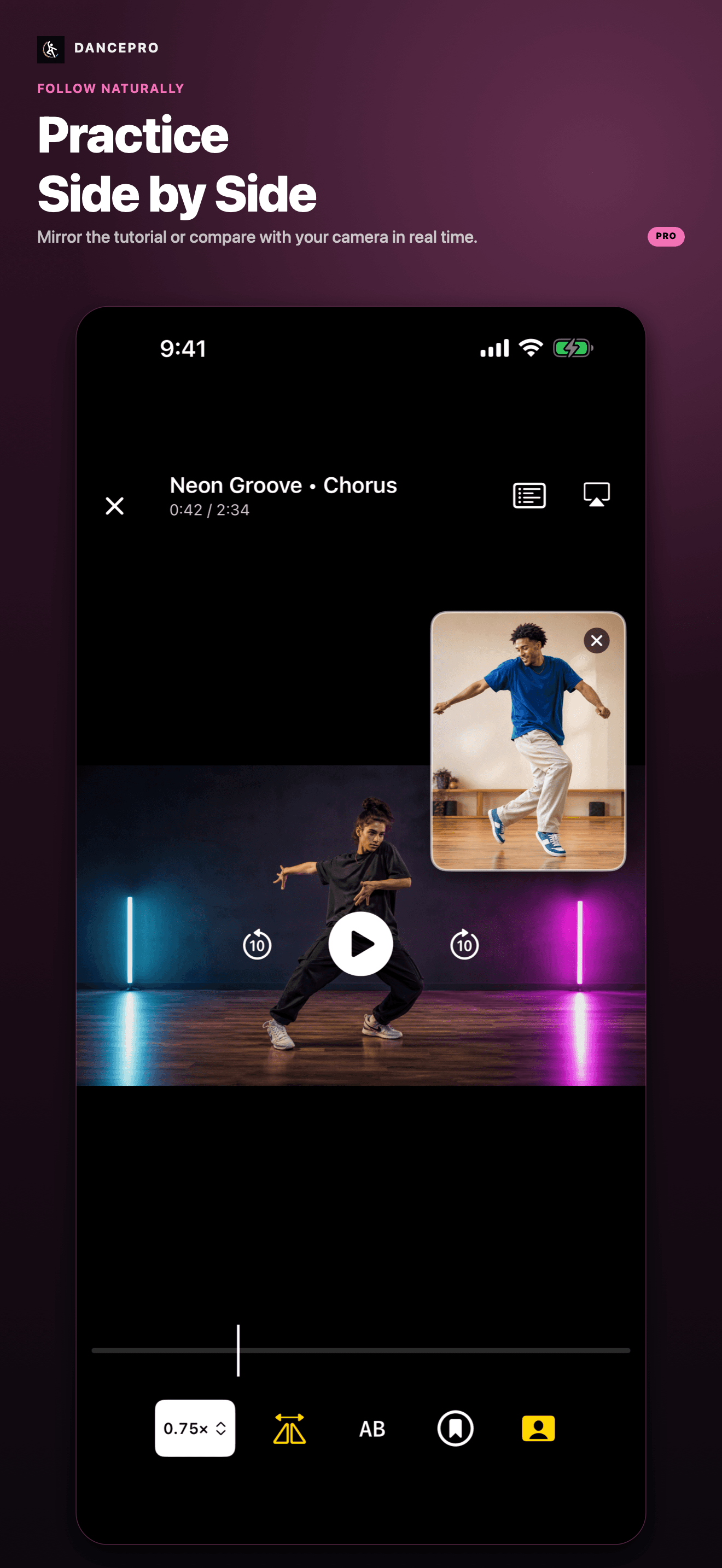
DancePro brings an imported dance video and your camera practice into one workspace. You can mirror or slow the reference, loop one phrase, and record a run for review without requiring a full-length mirror in the room.
Use the tool selectively. Watch when you need information, record when you need evidence, and move without either when you need to test what your body remembers. If a technique is unfamiliar or potentially unsafe, seek qualified instruction rather than relying on a recording alone.
Your practice space can fit in your pocket.
Use camera practice, recording, mirroring, and focused playback in DancePro to work with saved dance videos even when a studio mirror is not available.
DownloadFrequently Asked Questions
Can I learn dance at home without a mirror?
Yes. A clear reference, safe space, phone recording, musical cues, and deliberate recall can support choreography practice without a mirror. A teacher is still valuable for technique, safety, and feedback that a video cannot provide.
Is a phone camera as good as a dance mirror?
It serves a different purpose. A mirror gives immediate feedback while you move; a recording shows the completed attempt from an audience-like view. Alternating both kinds of feedback with no-visual practice is often more useful than treating either as the only answer.
Where should I put my phone when recording dance?
Place it on a stable support, far enough away to keep your entire body and travel path in frame. Avoid extreme low or high angles when your goal is movement comparison, and check lighting and background privacy first.
How much room do I need to practice dance at home?
It depends on the choreography. Test the full pathway slowly with arms extended and include room for stopping safely. Adapt or omit traveling, turning, jumping, or partner movement when the space or floor is unsuitable.
Should I watch myself while practicing dance?
Watch when visual information helps answer a specific question, then include attempts without looking. Constant self-watching can make it difficult to know whether the movement is remembered independently.
Keep Learning
Sources and Further Reading
These references informed the guide. Dance training is individual; use qualified instruction for technique, injury concerns, and movements that are new or unsafe in your space.