DancePro guide
Why Your Dancing Looks Awkward on Camera
Seeing your dancing on video can feel harsher than seeing it in a mirror. The camera removes the feeling of the movement and gives you a fixed audience view. That difference is useful evidence—but it is not a verdict on whether you belong in dance.
Published September 5, 2026
Quick Answer
Dancing often looks awkward on camera because the recording reveals timing, unfinished shapes, unclear weight shifts, small or uncontrolled energy, and habits that are difficult to notice while moving. Camera angle and unfamiliarity with your recorded image can intensify the reaction. Review one category at a time, compare the same short phrase with the reference, make one specific correction, and record again.
The Camera Is Different From the Feeling
While dancing, you experience effort, rhythm, intention, balance, and momentum from inside your body. A recording contains none of that sensation. It shows one visual angle after the moment is over. The gap between a vivid internal experience and a flat external image can feel surprisingly personal.
A mirror is also familiar because you see a reversed image and can correct yourself in real time. Video may show the opposite orientation and preserve moments you would have fixed or forgotten. Give yourself time to become familiar with this view before treating the first emotional reaction as technical analysis.
Check the Recording Before You Check the Dancing
Framing
Keep the full body, including feet and hands, visible. Cropping a pathway can make movement look smaller or unclear.
Height and angle
A very low, close, tilted, or wide-angle position changes proportions and lines. Use a stable, level setup when the goal is comparison.
Distance
Leave enough space around the body to see travel and direction. A dancer filling the frame has no visual room to move.
Lighting and clothing
Make sure limbs are distinguishable from the background. The purpose is readable movement, not a polished social-media production.
The Five-Pass Dance Self-Review
- 1. Timing: Watch once for starts, accents, and landings. Do not judge shapes yet. Identify one count that arrives early or late.
- 2. Weight and pathway: Check which foot holds your weight, how you travel, and whether the preparation allows the next movement to happen.
- 3. Shapes and completion: Pause at two or three key positions. Look for arm direction, hand intention, focus, level, and whether the movement reaches its endpoint.
- 4. Transitions and texture: Watch how the movement changes between pictures. Compare sharp versus sustained qualities, rebound, groove, and changes of energy.
- 5. Performance: Only after the mechanics are clear, review gaze, commitment, breath, and relationship to the music. Ask what you are communicating rather than whether you look cool.
Compare Specific Evidence, Not Entire Bodies
Place your take beside the reference and choose a single observable question: Do both dancers arrive on count five? Does the elbow finish at the same level? Does the weight settle before the turn? Precise questions lead to changes you can practice.
Avoid broad labels such as awkward, bad, stiff, or untalented. They combine many possible differences and provide no next action. Replace “I look stiff” with an observation such as “my knees stop bending during the groove after count four.”
Use neutral language
Describe what the video shows as if you were helping another dancer: early, late, smaller, unfinished, facing front, weight on the left. Observation is more useful than insult.
Make One Correction and Record Again
Choose the correction with the greatest effect on the phrase. Timing and weight placement often influence several later details, while changing a hand shape may not fix the transition beneath it. Loop the relevant counts, practice the correction, and capture another take from the same angle.
Keep the two recordings long enough to compare them. Progress is easier to recognize when the reference conditions stay stable. If the second take does not change, make the task smaller or ask a teacher to identify what you cannot yet see.
Use DancePro for Private, Focused Review
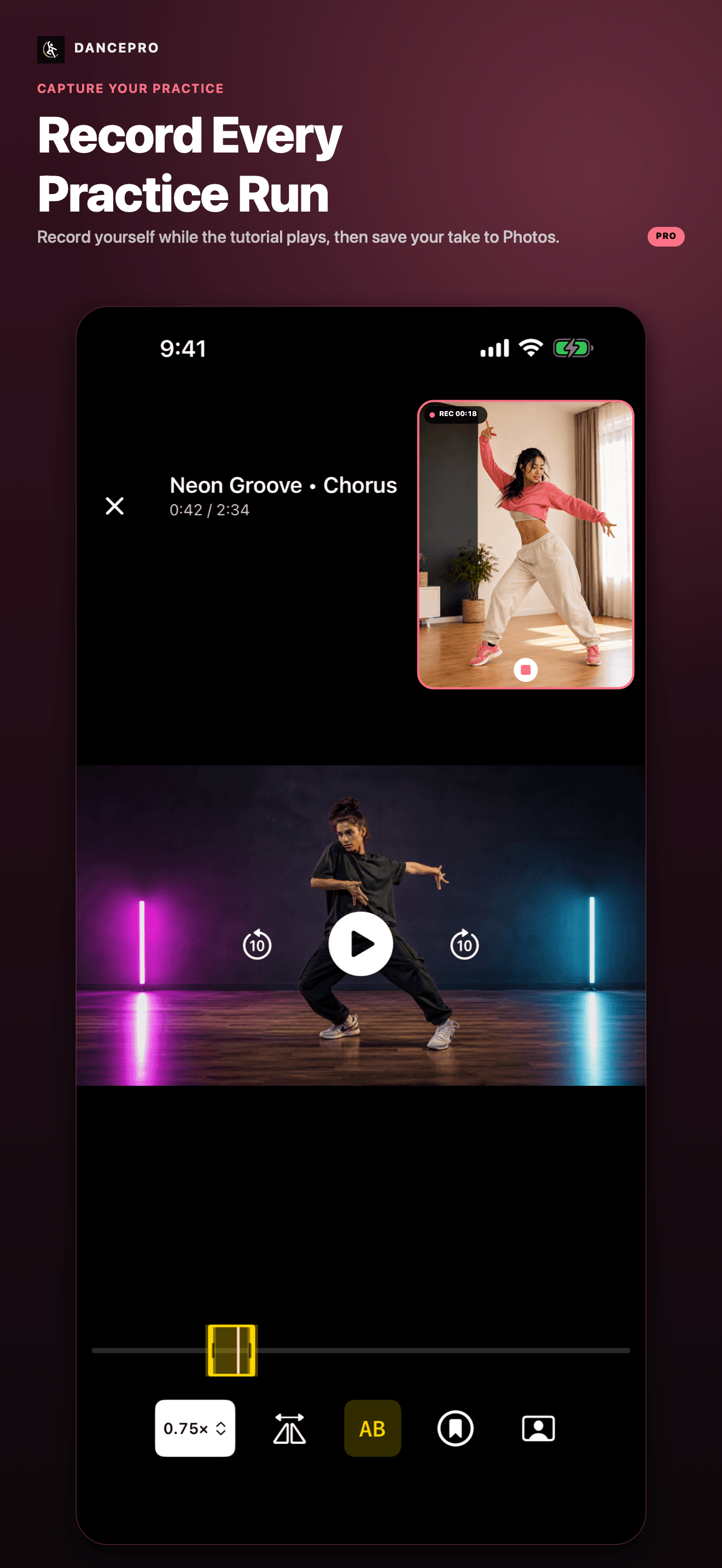
DancePro lets you practice with an imported reference and record a run without turning every attempt into something you must post. Slow the difficult moment, loop it, and compare your next take with a clear technical question in mind.
The goal of recording is not to become comfortable criticizing yourself. It is to create a feedback loop that becomes calmer and more specific over time: notice, adjust, try again, and keep the parts that are working.
Turn “awkward” into one answerable question.
Record a private practice run in DancePro, return to the exact count, and compare one detail at a time with the dance video you are learning from.
DownloadFrequently Asked Questions
Why does my dancing look better in the mirror than on camera?
A mirror is a familiar reversed image with continuous live correction. A recording is delayed, fixed, and often shown from an unfamiliar audience view. Camera position can also change proportions. The difference does not automatically mean the mirror was false or the video is objectively bad.
How can I look less stiff when dancing?
Identify where the stiffness appears rather than trying to become generally looser. Check breath, joint release, weight transfer, groove, and whether you finish one movement before beginning the next. Work on one short phrase and compare another recording.
What should I look for when reviewing a dance video?
Review timing first, then weight and pathway, key shapes, transitions and texture, and finally performance. One pass per category prevents a vague reaction from replacing useful observation.
How often should dancers record themselves?
Record when the video will answer a question: after learning a phrase, before and after a correction, or during a periodic progress check. Constant filming can interrupt practice; never filming removes a valuable source of external feedback.
Should I post my dance practice videos?
Only if you want to and have permission to share the choreography and music. A useful practice recording can remain private. Its first purpose is feedback, not performance or approval.
Keep Learning
Sources and Further Reading
These references informed the guide. Dance training is individual; use qualified instruction for technique, injury concerns, and movements that are new or unsafe in your space.