DancePro guide
A 20-Minute Dance Practice Routine That Works
Twenty focused minutes can move a routine forward when every minute has a job. This plan balances warming up, learning, repetition, self-review, and recall without pretending that one short session replaces class or conditioning.
Published September 5, 2026
Quick Answer
A useful 20-minute dance practice has five parts: prepare your body and space for three minutes, review from memory for three minutes, learn or repair one phrase for six minutes, record and review for four minutes, then perform and log the result for four minutes. Choose one specific goal before starting, and finish by naming the first task for your next session.
What Twenty Minutes Can—and Cannot—Do
A short session is excellent for keeping choreography available, solving one transition, reviewing a class combination, or maintaining a consistent learning rhythm. It is too short to solve every technical, strength, mobility, memory, and performance need in the same day.
Choose a narrow outcome such as “remember the second eight-count,” “land the turn on count five,” or “perform the chorus without watching.” A concrete goal turns twenty minutes into training; “get better at this dance” is too large to guide the session.
The 20-Minute Dance Practice Plan
- 1. Minutes 0–3: Prepare: Clear the floor, check shoes and surface, and warm up in a way appropriate to the style and your body. Play the relevant music and rehearse the basic groove or movement quality.
- 2. Minutes 3–6: Recall: Attempt yesterday's material before watching the reference. Mark rather than performing full-out if your body is not ready. Notice the first uncertain count.
- 3. Minutes 6–12: Learn or repair: Open one bookmark, slow the video if needed, and loop the smallest meaningful phrase. Work on one layer at a time, then connect it to the surrounding counts.
- 4. Minutes 12–16: Record and review: Capture one take. Review timing first, then one visual detail. Choose a single correction and record again instead of collecting many unused videos.
- 5. Minutes 16–20: Perform and close: Run the largest section you can perform safely, preferably without following the screen. Log what improved and name the exact place where the next session should begin.
Use a Different Focus on Different Days
Learning day
Spend the six-minute work block decoding a new phrase and finish with a low-energy memory test.
Cleaning day
Bring back familiar choreography and use the recording block to compare timing, shapes, or transitions.
Retention day
Attempt several sections from different starting points, checking the video only after each recall attempt.
Performance day
Use more of the session for larger runs, musical intention, focus, and recovering without stopping.
The 10-Minute and 40-Minute Versions
For ten minutes, prepare for two, recall for two, work one phrase for four, and close with a two-minute test and note. Do not skip preparation to squeeze in more repetitions. Reduce the amount of choreography instead.
For forty minutes, do not simply double every block. Add a short rest, give learning and cleaning separate ten-minute sections, and finish with several spaced full or partial runs. Longer sessions create fatigue, so preserve quality and stop if the environment or movement is no longer safe.
How Often Should You Practice Choreography?
The right frequency depends on the difficulty, deadline, physical demands, and other training you do. For memory, several short reviews across a week are often more practical than waiting for one large session. For conditioning or technique, follow guidance appropriate to your style and training level.
Track consistency without turning it into punishment. A streak can show that you returned, but it cannot show whether the practice was attentive. Record the phrase, focus, duration, one improvement, and next step. Those details make the next session easier to begin.
End with a doorway
Write one sentence before you stop: “Next time, begin at the transition into the chorus and check the left foot on count six.”
Keep the Session Moving in DancePro
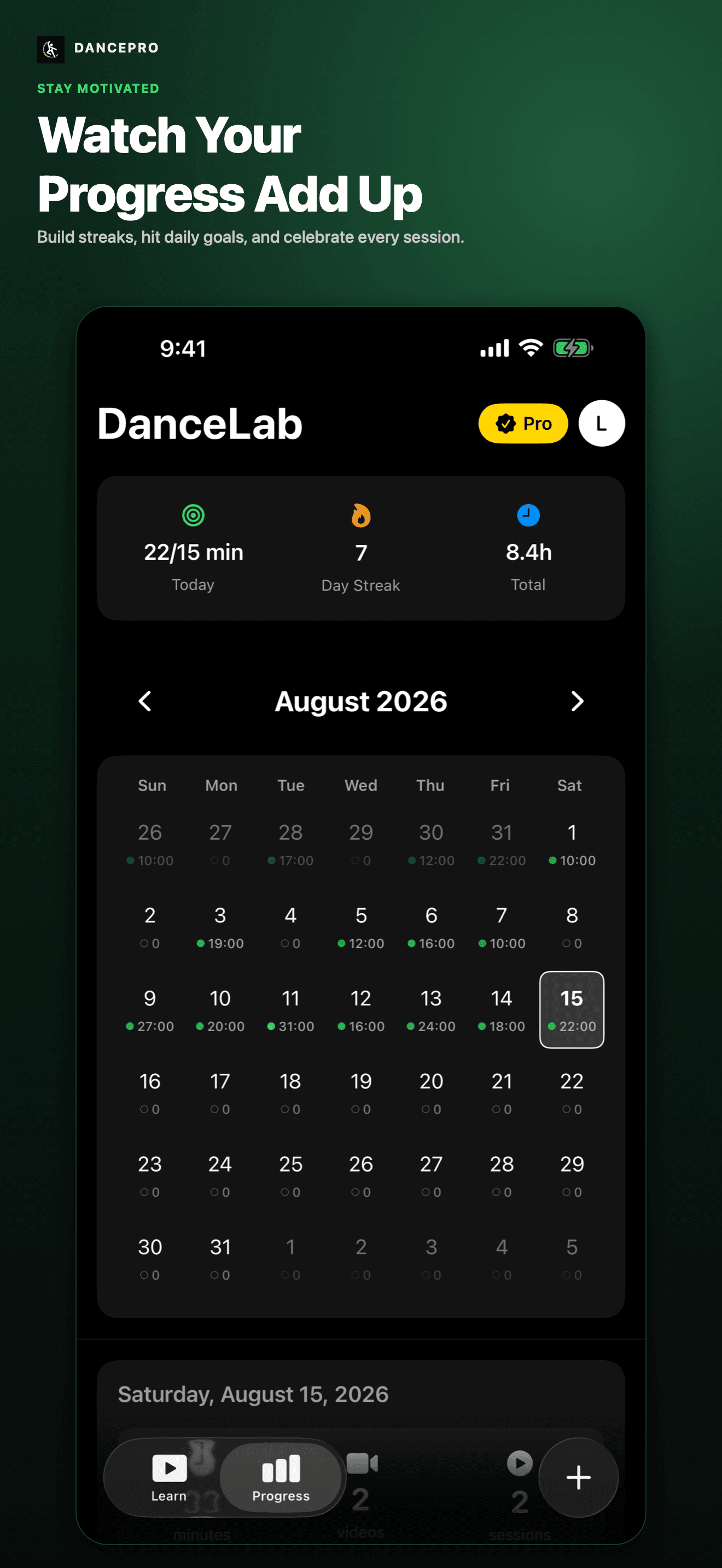
DancePro keeps saved reference videos, bookmarks, speed, looping, camera practice, recordings, and progress in one place. Set up the phrase before the timer starts, then use the session for movement rather than managing several apps.
Progress statistics are best treated as context, not a score. The most important evidence is specific: you remembered the section, corrected the transition, or needed less visual help than yesterday.
Make the next twenty minutes count.
DancePro keeps the video, focused loops, recordings, bookmarks, and practice progress together so a short session can begin where the last one ended.
DownloadFrequently Asked Questions
Is twenty minutes of dance practice enough?
It is enough for a focused choreography task such as retention, learning one phrase, or reviewing a recording. It is not a complete training prescription and may not cover technique, conditioning, mobility, rehearsal, and recovery needs.
Should I practice dance every day?
Daily high-intensity practice is not automatically better. Frequency should reflect your movement load, experience, recovery, and guidance from teachers or health professionals. A daily session can also be light mental review, marking, or video study rather than full-out dancing.
What should I practice first in a dance routine?
Start with the section tied to your current goal. That may be the most difficult transition, the chorus you want to perform, or the oldest phrase beginning to fade. You do not always need to start at the beginning.
How do I know whether dance practice is working?
Test a specific result: recall the phrase without watching, perform at a higher tempo without losing form, compare two recordings, or execute the transition from several starting points. Time spent alone does not measure learning quality.
What should I write in a dance practice log?
Record the date, routine, section, duration, practice focus, one improvement, one unresolved question, and the first action for next time. Keep it brief enough that you will actually use it.
Keep Learning
Sources and Further Reading
These references informed the guide. Dance training is individual; use qualified instruction for technique, injury concerns, and movements that are new or unsafe in your space.