DancePro guide
How to Learn K-Pop Choreography From Dance Videos
K-pop choreography is built to read as a complete performance: exact timing, recognizable point moves, detailed textures, and often complex group formations. A good video-learning method helps you separate those layers instead of trying to copy the entire screen at once.
Published September 5, 2026
Quick Answer
To learn K-pop choreography from video, choose a fixed-camera dance-practice or tutorial video, select one member to follow, and confirm whether the reference is mirrored. Learn the point choreography or chorus in short phrases, separating footwork and upper body when necessary. Loop difficult transitions, raise the speed gradually, record yourself, and compare timing and shapes before adding facial expression and full performance energy.
Choose the Right Kind of K-Pop Video
Tutorial
Best for verbal explanation, counts, simplified views, and a teacher who identifies details that are hard to see at speed.
Dance-practice video
Often best for a full-body, relatively stable view of the official choreography, timing, formations, and relationships between members.
Fixed-camera or full-cam performance
Useful for seeing stage spacing and performance quality without constant editing, although costumes and lighting may hide details.
Fancam
Useful for following one member through a performance, but camera movement, angle, and partial obstructions can make precise learning harder.
Music video or short social clip
Useful for inspiration and point choreography, but cuts, changing lenses, and incomplete body framing make it a weaker sole reference.
Choose One Member Before You Learn
In group choreography, each member can have a different pathway, facing, level, or transition even when the point move is shared. Pick the member whose part you intend to perform and follow that person consistently through the section.
A center member is visually easy to locate, but center positions change. Use clothing, hair, or position relative to another member as a temporary tracking cue. If a formation hides the performer, consult a fancam or tutorial rather than borrowing movements from a different part without noticing.
Confirm Whether the Video Is Mirrored
A mirrored K-pop video is horizontally flipped so you can copy the side shown on screen. An official dance-practice video is not necessarily mirrored, and fan-uploaded versions may or may not state the orientation clearly. Look for reversed studio signs or clothing text and compare with the official source.
Mirroring is convenient for solo learning, but formations still belong to the original stage orientation. If you plan to join a cover group, agree on member assignments and directions before everyone builds different versions into memory.
Learn the Chorus in Layers
- 1. Map the music: Listen for the chorus entrance, repeated hook, percussion accents, lyric cues, and any count that breaks the expected pattern.
- 2. Mark the feet and weight: Learn steps, level changes, and direction at low intensity. Correct weight placement makes later upper-body detail easier.
- 3. Add upper body: Study arms, torso, head, and focus separately when coordination is dense, then reconnect them to the footwork.
- 4. Loop transitions: Practice the counts before and after each point move, not only the recognizable pose itself.
- 5. Raise the speed: Move through a tempo ladder and keep the pathway readable instead of making every action smaller to survive full speed.
- 6. Add performance last: Once timing and direction are stable, study dynamics, focus, facial expression, and the character of the performer you chose.
Point Choreography vs. the Complete Routine
Point choreography is the recognizable hook designed to make a section memorable. Learning it first can provide motivation and a musical landmark, but it does not automatically teach the transitions, verses, dance break, or the member's changing role in a formation.
Decide what “learn the dance” means for you. A chorus cover, a solo adaptation, and an exact member part are different projects. Set the scope clearly so you can choose the right source video and know when the result is complete.
For beginners
Choose a chorus you genuinely enjoy and a video with a stable full-body view. A short section learned well builds more skill than an entire difficult routine followed vaguely.
Build a K-Pop Practice Library in DancePro
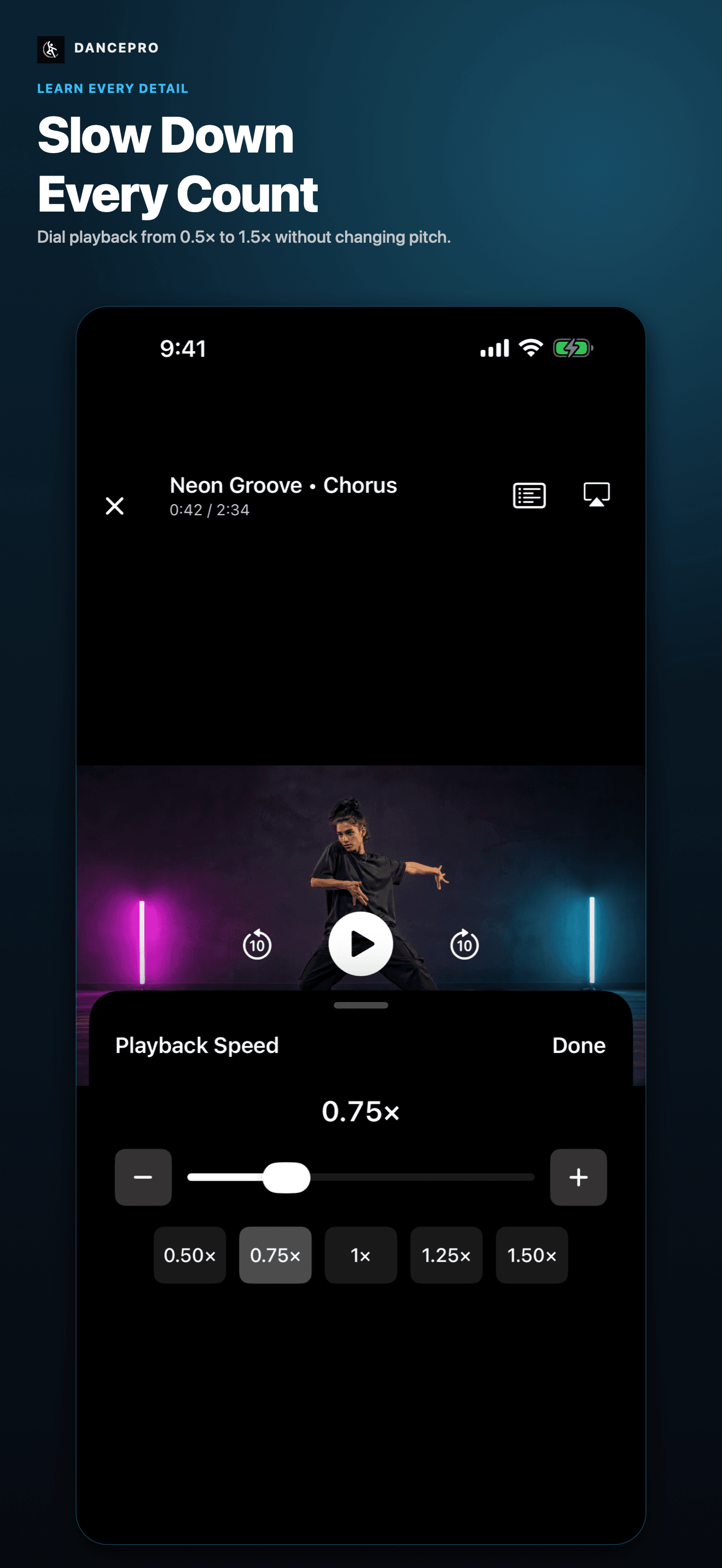
With DancePro, a K-pop video saved to your device can become a reusable practice reference. Mirror the view, slow detailed counts, loop the chorus or formation change, bookmark sections by member or lyric, and record yourself beside the source.
Keep credit and permissions attached to the source. Practice tools do not grant permission to download, reproduce, or publish someone else's choreography, music, or video. Use lawful saving options and follow platform, creator, studio, and event rules when sharing a cover.
Keep the chorus on repeat—without losing your place.
Use DancePro to mirror, slow, bookmark, loop, and record practice with any suitable K-pop dance video saved on your iPhone or iPad.
DownloadFrequently Asked Questions
What is the easiest way to learn K-pop choreography?
Start with one chorus and a clear tutorial or fixed-camera dance-practice video. Follow one member, confirm the orientation, learn short phrases below full speed, and separate footwork from upper-body details before combining them.
Should K-pop dance-practice videos be mirrored?
Mirroring can make solo follow-along learning easier, but the original video preserves stage orientation and formations. Use the view that supports your current task and confirm directions with a cover group before rehearsing together.
Which K-pop member should I follow in a dance video?
Follow the member whose part you want to perform, not automatically whoever is in the center. If you are creating a solo adaptation, choose the pathway that keeps the important point choreography readable and safe in your space.
How do I learn fast K-pop choreography?
Reduce the phrase, lower the playback speed, establish footwork and weight first, and loop the transition with a musical lead-in. Increase speed in stages and return to slow review when a specific detail collapses.
Can beginners learn K-pop dances from videos?
Yes, if the section and source match their current ability. Beginner tutorials, shorter point choreography, and clear fixed-camera videos are better starting places than copying a heavily edited performance at full speed. Seek instruction for unfamiliar technique or demanding movement.
Keep Learning
Sources and Further Reading
These references informed the guide. Dance training is individual; use qualified instruction for technique, injury concerns, and movements that are new or unsafe in your space.