DancePro guide
How to Learn Choreography From Any Dance Video
A good dance video contains everything you need to study a routine, but an ordinary video player is built for watching, not practicing. This method turns any suitable saved video into a sequence you can see clearly, remember, and eventually perform without the screen.
Published September 5, 2026
Quick Answer
To learn choreography from a video, first watch the complete routine without copying it. Choose one clear dancer, divide the choreography into short musical phrases, mirror the video if needed, and learn each phrase slowly. Loop the difficult section, connect it to the next section, record yourself, and raise the speed only after you can recall the movement without following the screen.
Why Dance Videos Feel Harder Than Live Instruction
A video gives you a complete performance, but it does not automatically tell you where to look, when one phrase ends, which direction is correct, or what deserves repetition. At full speed, a beginner is often still interpreting one movement while the dancer on screen has already started the next one.
The solution is not to watch the entire video more intensely. It is to change the video from a performance into a practice reference. That means reducing the amount of movement you are solving at one time and giving yourself a reliable way to return to the same moment.
Choose a Useful Reference Video
The best source is not always the most exciting performance. Look for a fixed or predictable camera, a full-body view, enough light to see the feet and hands, and as few cuts as possible. A tutorial can explain technique, while a clean performance or dance-practice video can show timing and texture. You may use both for the same routine.
If several dancers are visible, decide who you are following before you begin. Changing between performers creates accidental changes in direction, styling, and formation. Use a video you are allowed to save or import, and keep the creator's original post as your source of truth.
The Seven-Step Video Practice Method
- 1. Watch the full routine: Watch two or three times without dancing. Notice repeated sections, musical accents, changes of direction, and the part you most want to learn.
- 2. Orient the picture: Decide whether you need a mirrored view. If copying the screen produces the opposite arm or leg, flip the reference before that direction becomes a habit.
- 3. Mark the phrases: Divide the routine at musical boundaries such as an eight-count, lyric, beat change, or formation change. Give each phrase a simple name.
- 4. Learn below full speed: Start slowly enough to finish each action rather than chase the next one. Separate feet, arms, and pathway when a movement is dense.
- 5. Loop the smallest useful section: Repeat a complete action or transition, not an arbitrary two-second fragment. The loop should include enough lead-in to hear the cue.
- 6. Recall, connect, and record: Look away from the reference, perform the phrase from memory, connect it to the next phrase, and record one attempt for review.
- 7. Build back to full tempo: Increase speed in manageable steps. At each speed, keep the timing and shapes you established during slower practice.
Learn Phrases, Then Practice the Seams
Dancers often know section A and section B but freeze between them. That is because the transition is its own piece of choreography: your weight must finish in the right foot, your focus must travel, and one shape must release into another. Include the last count of A and the first count of B in a separate loop.
Once the seam works, practice A plus B without pausing. Then begin from B instead of always starting at the top. Multiple starting points make the routine more resilient when memory slips.
Stop Following Before You Feel Ready
A reference is useful while you are decoding movement, but constant visual following can hide what you actually remember. After a few repetitions, pause or turn away and mark the phrase from memory. A hesitation tells you exactly where the memory becomes uncertain.
Return to the video only to answer that specific question. This cycle—attempt, notice, check, attempt again—is more informative than repeating the original ten times while keeping your eyes fixed on the dancer.
Use DancePro as a Practice Space, Not a Substitute Teacher
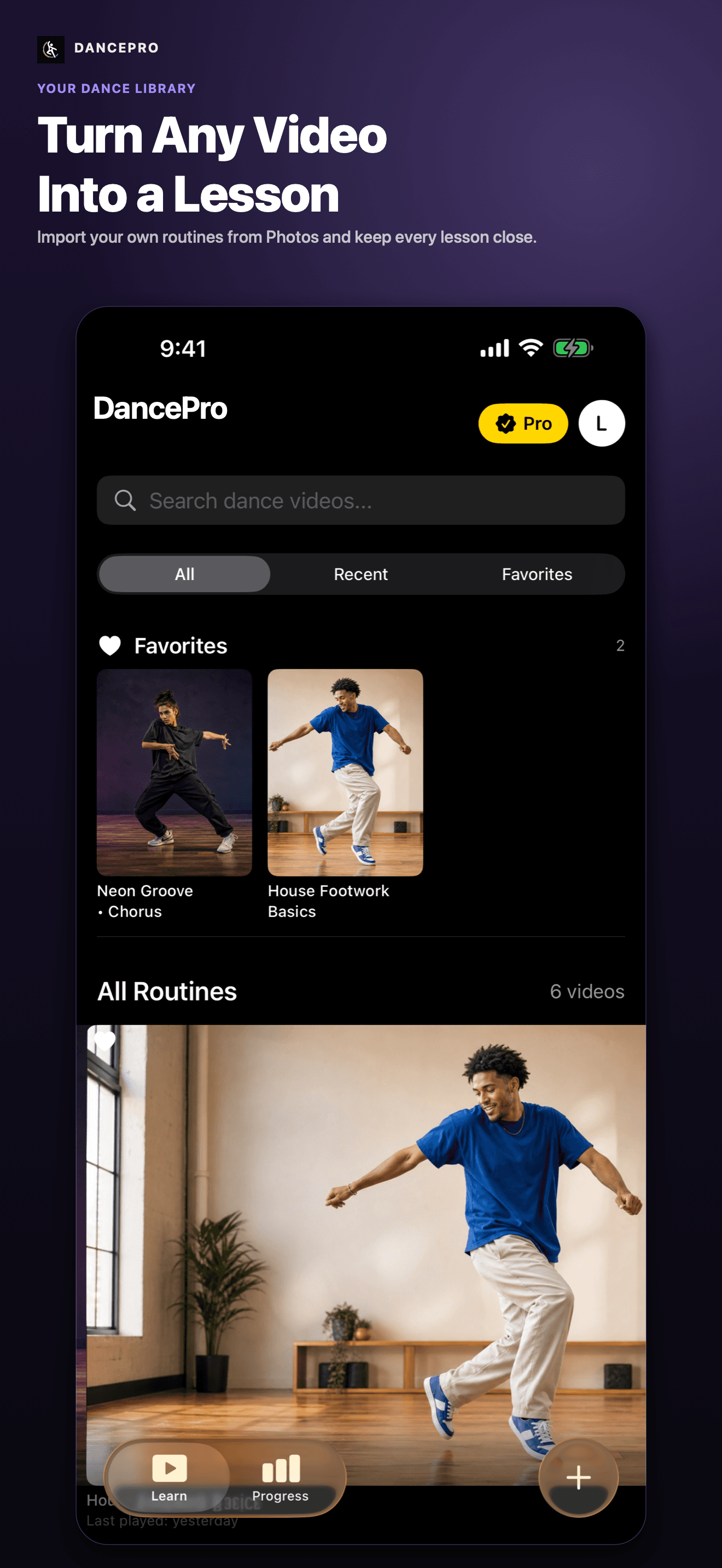
DancePro is designed for the mechanics of video practice: keep saved reference videos in one library, change playback speed, mirror the picture, create exact A–B loops, add named bookmarks, practice beside the camera, and record a run. Those controls reduce the interruption between noticing a problem and repeating it.
A video tool cannot correct unsafe technique, explain the intention of the choreographer, or replace feedback from a qualified teacher. Use it to study material you have permission to practice and to arrive at class with clearer, more specific questions.
A useful rule
If you have repeated the same section several times without learning anything new, change the task: slow it down, shorten the loop, isolate one body part, or ask for feedback.
Turn the video into a practice session.
DancePro gives saved dance videos the controls practice needs: slow motion, precise loops, mirroring, bookmarks, camera comparison, recording, and progress tracking on iPhone and iPad.
DownloadFrequently Asked Questions
Can you learn to dance just by watching videos?
Videos can be effective for learning choreography and reviewing movement, especially when you slow, segment, and actively recall what you see. They are less reliable for diagnosing technique or safety. Classes and teacher feedback remain valuable, particularly for unfamiliar or high-risk movement.
Should I learn choreography with counts or lyrics?
Use whichever cue makes the timing easiest to retrieve. Counts reveal musical structure; lyrics, percussion, and sound effects can create memorable landmarks. Many dancers combine them, such as “turn on seven, land on the word home.”
How much of a dance should I learn at once?
Start with one coherent phrase, often four or eight counts. Fast or unfamiliar movement may need a smaller unit. The section is ready to grow when you can perform it without copying the screen and connect it cleanly to what follows.
Should I learn a dance at full speed?
Watch it at full speed first so you understand the overall timing and energy. Learn difficult details more slowly, then return to full tempo in stages. Slow practice should preserve the rhythm and pathway rather than turn the movement into unrelated poses.
What kind of dance video is easiest to learn from?
A fixed-camera, full-body video with clear lighting and minimal cuts is usually easiest. Tutorials add explanation; performance videos show the finished quality. For group choreography, choose one performer and follow that person consistently.
Keep Learning
Sources and Further Reading
These references informed the guide. Dance training is individual; use qualified instruction for technique, injury concerns, and movements that are new or unsafe in your space.