Dots guide
Does a Life Calendar Motivate You or Make You Anxious?
A life calendar turns the abstract idea of a lifetime into a simple grid of weeks. Used well, it is not a countdown, a habit tracker, or a streak system. It is a way to see time clearly enough to choose the next week with more care.
Published July 7, 2026 · Updated July 10, 2026
Quick Answer
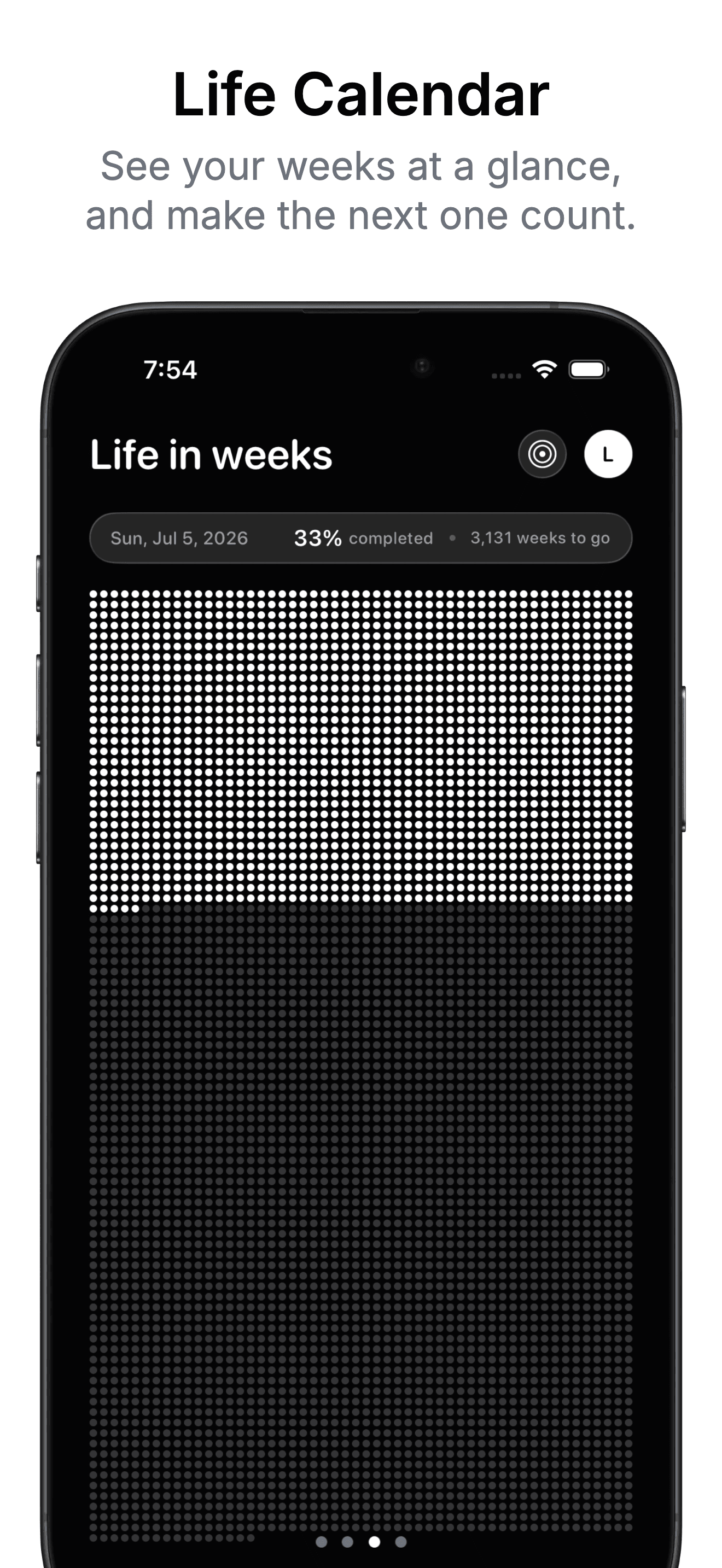
A life calendar is a visual map of your life in weeks. Each dot, square, or box represents one week. The weeks you have lived are filled in, and the weeks ahead remain open. The format is often used for reflection, goal setting, life planning, journaling, and memento mori practice.
What Is a Life Calendar?
A life calendar, sometimes called a life-in-weeks calendar, is a grid that shows a life as a finite set of weekly units. Instead of thinking in vague phrases like someday, later, or when life calms down, you see a plain visual structure: past weeks, this week, and future weeks.
The idea became widely known through Tim Urban's Wait But Why essay, Your Life in Weeks, which popularized the striking 90-year, 4,680-week grid. But the deeper idea is older than a poster or a blog post. It belongs to a long tradition of tools that make time visible: calendars, diaries, year-in-pixels charts, habit trackers, and memento mori reminders.
The power of a life calendar is not mathematical precision. It is perspective. A year can feel enormous when you are stuck inside a difficult season. A decade can feel invisible when you are busy. A week is small enough to act on and large enough to matter.
Why Weeks Work Better Than Years or Days
Years are easy to name but hard to feel. Days are concrete but noisy. Weeks sit in the middle. Most people already organize life by weeks: work weeks, weekends, classes, routines, recurring calls, meals, workouts, chores, and recovery.
A weekly grid creates a practical scale for reflection. You can ask better questions: What did this week contain? Did it move me toward something I care about? Did I rest? Did I see the people I love? What would make next week feel more honest?
Behavioral research around time perspective points in the same direction: how people perceive their remaining time can influence which goals feel important. Socioemotional selectivity theory, associated with psychologist Laura Carstensen, argues that perceived time horizons shape whether people prioritize exploration and future-oriented goals or emotionally meaningful goals. A life calendar makes that horizon visible, which can help you choose more deliberately.
How to Calculate a Life Calendar
The basic formula is simple:
For example, a 90-year life calendar has about 4,696 calendar weeks by the solar-year formula, though many popular grids simplify this to 90 x 52, or 4,680 weeks. An 80-year calendar has a little over 4,170 weeks. A 100-year calendar has about 5,218 weeks.
Choose a lifespan as a visual frame, not a forecast. The CDC's National Center for Health Statistics lists U.S. life expectancy at birth as 79.0 years in its latest FastStats page, but an individual life is affected by health, family history, geography, behavior, randomness, and many things outside personal control. The point is not to predict your final week. The point is to notice the week you are in.
How to Use a Life Calendar Without Making It Grim
A life calendar can be clarifying, but only if it stays humane. The healthiest version is less like a productivity scoreboard and more like a quiet mirror.
- Mark life chapters. Color school, moves, relationships, jobs, creative seasons, recoveries, and transitions. The past becomes a map instead of a blur.
- Reflect weekly. Add one sentence or note to the week: what mattered, what changed, what you want to remember.
- Use future dots gently. Place meaningful dates on the grid, but avoid filling the future with pressure. A calendar should create orientation, not dread.
- Look for patterns. Notice when you are spending many weeks in a mode you did not consciously choose.
- Zoom out when needed. If a full-life view feels intense, use a year calendar, a project timeline, or today's minutes instead.
Life Calendar vs. Habit Tracker
Habit trackers are built around repeated actions. Drink water. Meditate. Exercise. Read. Check the box, keep the streak alive, and try not to break the chain. That structure can be helpful when you are building a narrow behavior, but it can also make your life feel like a compliance system.
A life calendar works differently. It does not ask whether you completed a task today. It asks you to notice the time you are already living. The unit is not a checkmark. It is a week, a day, or a minute that will not repeat.
That difference is why Dots is intentionally not a streak app. Dots is closer to a time-awareness tool or an intentional living app: something you glance at, understand, and put away. The goal is not to win the calendar. The goal is to live with more attention.
If maintaining a streak has started to feel heavier than the habit itself, read our guide to habit tracker pressure and observing time instead.
Life Calendar vs. Memento Mori Calendar
A memento mori calendar is usually explicit about mortality: remember that life ends. A life calendar can include that reminder, but it does not have to be severe. It can also be a family-memory map, a personal timeline, a planning surface, or a way to practice gratitude for ordinary weeks.
The difference is tone. Memento mori asks, "What if time is limited?" A life calendar asks, "Given that time is real, what should this week be for?" That small shift matters. One can feel like a warning; the other can feel like stewardship.
Printable Poster or Life Calendar App?
A printed life calendar is powerful because it is physical. You can hang it on a wall, mark it by hand, and watch chapters accumulate over years. The downside is that it is fixed: one lifespan, one layout, one location.
A life calendar app is better when you want the grid to update automatically, live on your phone, show up as a widget, or support more than one timeline. You might want a lifetime view, a year view, a day view, a trip countdown, a sabbatical plan, a school term, or a custom milestone. Digital timelines can stay private and flexible.
Dots is designed around that digital version. It shows life in weeks, the year in days, today in minutes, and custom timelines as calm dot grids. The goal is not to make time louder or turn intention into a streak. It is to make time visible enough to respect.
Try a calmer life calendar with Dots.
Dots turns finite time into quiet grids for iPhone: life in weeks, year in days, today in minutes, and custom timelines for the seasons that matter, without streak pressure.
DownloadA Simple Weekly Practice
If you want to use a life calendar without overthinking it, try this five-minute ritual at the end of each week:
- Mark the week that just ended.
- Name one thing worth remembering.
- Name one thing you are glad you gave time to.
- Name one thing you want to protect next week.
- Leave the rest of the grid alone.
That last step is important. The grid is not asking you to solve your life in one sitting. It is asking you to notice the next square.
Frequently Asked Questions
What is a life calendar?
A life calendar is a visual grid that represents a human life as individual weeks. Filled dots or boxes usually show weeks that have already passed, while empty ones show weeks still ahead based on a chosen lifespan.
How many weeks are in a life calendar?
It depends on the lifespan you choose. A 90-year life calendar has 4,680 weeks, while an 80-year calendar has a little over 4,170 weeks. The number is a planning lens, not a prediction.
Is a life calendar the same as a memento mori calendar?
They overlap. A memento mori calendar emphasizes remembering mortality; a life calendar can do that, but it can also be a practical reflection tool for life chapters, goals, habits, and meaningful weeks.
Is a life calendar a habit tracker?
No. A habit tracker measures repeated actions and often rewards streaks. A life calendar is a reflection tool for seeing time, noticing patterns, and choosing the next week more intentionally.
Is using a life calendar healthy?
It can be, if it helps you notice time gently and choose the next week with care. If a full-life view feels stressful, use a smaller scope such as the current year, a project timeline, or today.
Should I use a life calendar app or a printable poster?
A poster is tactile and visible at home. An app is better if you want automatic updates, widgets, privacy, notes, and multiple timelines. Dots is designed for the app version: calm, local, and glanceable.